Sunday, October 11, 2015

"...I'm going to have to help myself"

[I’m] Chong Yang-Thao, [born on] November 29th, 19731, in Luang Prabang, Laos.  I remember some things about the transition into Thailand when war came and we left Laos. I was probably about four years old. We came into the refugee camp, Ban Nam Yao, in the northwest side of Thailand. We lived in the camp for about three years [and] it was tough. We were in transition and we were living in really harsh conditions where hunger was common, fear of the Thai government, and just missing my mother who worked constantly. We were moving around all the time because my father died when I was very young from dioxin poison. In the Hmong community, when you don’t have a father, you have no status and you were at the mercy of your clan, which is very patriarchal. This transience gave me no sense of security and eventually hopelessness really seeped [in]. 


(Picture 1) The arrow points to where Chong Yang-Thao was born. 


Three years [later] we came to Minnesota. My mother was forced into a marriage where she was second wife to a very cruel man. He took her paperwork, and he gave my mother’s identity to his first wife. He took his wife, two sons, my brother, my sister, and me, to Minnesota without our mother. The journey here was lonely and scary because we were with his family and they didn’t treat us well. We got here March of 1980, and it was snowing, it was beautiful and it was foreign. I don’t remember feeling the cold, I just marveled at the snow, the clumps of it, thick, thick clumps of it. Real thick, sticky kind of snow, falling from the sky. We walked out of the plane and the first person [that] I recognized was my grandma. A wonderful thing is that she was my best friend when I was small. My grandma didn’t have teeth. Probably a few teeth left in Thailand and she was gaunt, skinny, and sallow with her cheeks sunken in. When I saw my grandma again, she was full and she had full cheeks and a new set of teeth and I thought “well, this is a nice, nice introduction into America here.”


"Without money, without education, a woman has no place." 
We all squished into my uncle’s Dotson and came to a two bedroom apartment on Ashland Avenue, St. Paul. After dinner, my grandma took me by the hand and said “come here, I’m gonna teach you something.” She took me to her bedroom and she sat me down and took out a wad of cash and some coins and said “I’m gonna teach you about money in America. You see, because you are a girl, and you will be alone probably for some time, you need to know about money, and you need to know about making money.” That was my upbringing, these really forward thinking women. The first night, my induction into Americanism is women in my life show[ing] me the value of money. Without money, without education, a woman has no place. For me to understand, “this is your place and this is what you need, these are the tools that you need to establish yourself.” I think that was the moment of reinvention for me.

We lived in a one bedroom apartment across the street from JJ Hill Elementary. I attended school for the very first time as a kindergartener [and] that was wonderful. I remember I was wearing my best outfit; a white t-shirt with some print on the front, red polyester pants, and some soccer cleats [with] black [and] white stripes. We were taken to this Salvation Army to get clothes and we just took whatever fit. I remember that kids said a lot of things. They weren’t mean, they just probably didn’t know what to make of me. I walked in and they approached me and I didn’t understand [them]. I knew two phrases which were “no” and “I don’t know. We moved again after kindergarten to another apartment on Payne Avenue on the east side of St. Paul. Everything felt dirty to me [and] smelled bad. We were living with my step-father and step-mother. I think that the most miserable memory I’ve had was not so much the poverty and the sense of hopelessness, but just with this family that I felt so trapped with. My mother eventually found us and received the second set of paperwork from my uncle, in which she took my dead aunt’s identity. [After my] mom came, we all lived together in this single bedroom apartment and the hunger was there. We were left with step-mother and step-father who didn’t yell as us, didn’t verbally abuse us, just treated us with a severe negligence. We’re in America and conditions have not improved. We’re still hungry, we’re just hopeless. It was tough!


"We were so hungry to learn."
We were very much on our own. We were just trying to figure out how to navigate, how to go to school, how to get social services. We got welfare checks and food stamps, but my step-father hoarded all of it. Our only meals were at school so school became a place of safety. We loved it, we wanted to learn. We were so hungry to learn. I was proud and very much ashamed of what I went home to and didn’t know how to talk about it because I didn’t know about the legal consequences. When we went to school, we were very focused and we were able to compartmentalize. What was going on at home was totally separated. Then we were able to really absorb [the] academics and learn as much as we [could]. Now, when I see a lot of our new Americans I absolutely understand that school has to be a safe place.


"...in that time of bare footedness and hopelessness that I really had this determination..."
My yearning to be a teacher started when I was in the refugee camps. It just wasn’t believable that in that time of bare footedness and hopelessness that I really had this determination, this relief that it was just temporary. I remember walking around and hearing a bell. A school bell. I think I didn’t know that it was a school bell then, but when we went to investigate I saw some children and they were so clean. The thing I marveled at at the time was how neat they were, how clean they were. I coveted their places. I thought someday [that] I will go to school and be a teacher because to me, that was a position of change, a position of authority maybe even influence where I can change the lives of children. I think it was because I knew no other profession, no other career path. I just saw that and it stayed with me.  Going to school and having wonderful, warm teachers were just constant affirmations of what I wanted to be and what I wanted to do.


(Picture 2) This is an entrance to Ban Nam Yao
 refugee camp, a refugee camp where Chong Yang-Thao stayed. 

[The] school environment[s] were so different and nebulous to me. Like fragmented, watercolor-ish, because nothing was really solid. We were constantly moving around. Anytime the rent went up and we couldn’t afford it we moved out. Eventually our mother went to see a social worker and learned that she could take us back and could go and vy for us legally. When she took us from stepfather and stepmother we moved into an efficiency apartment with my mom. We played that game; rent goes up, we moved out. We were at all sorts of elementary schools and junior highs, all in St. Paul. The one junior high that was very tough for me was Battle Creek. We children have always faced very overt racism by our neighbors, by our classmates, [and] we often got beat up, but Battle Creek Junior High was [where] I was beaten severely one time. I was afraid of going into the bathroom, because each time I went to the bathroom I was pushed, I was shoved, [and] I was ganged up on. Then one time a boy really, really beat me up. Broke my glasses, pretty broken, pretty bruised, and teachers didn’t acknowledge it. I eventually had to learn self-advocacy and I went to the principle and said “I’m scared, but I want to come to school. This kid did this to me.” Brad Maner was the assistant principal who became the principal that hired me into St. Paul school system. He talked to me and said “okay, we’re going to help you feel safe.” He called the mother of this kid who beat me up and had a conference with her. I don’t know what went on, but my mom met with the assistant principal through an interpreter and after that, nothing else happened. I think it took for me to really want to go to school enough to say “hey, you know what, I can’t come to school feeling scared every day like this. I need to feel safe. So could you help me?” That took some guts now that I look back on it as a teacher, because I think that [for] many kids their solution to it would just be to skip school.


"We were constantly beat up, bullied, and teased."
I went to Como Park High School2 in the late eighties and nineties. It was rough. There were a lot of Hmong kids in gangs. It was a collective protection system so that we could go to school and we could feel safe. We were constantly beat up, bullied, and teased. I think I may have been protected by some gangs at some point, because I was beat up outside of Washington3 one day and some boys came to my rescue, but I was not ever a part of it. I found a small cohort of friends who were first generation or 1.5 generation. I found like-minded people who understood me, who came from the same background as I did, who were girls, and we didn’t have to explain [things to] each other. At first I thought “oh, Minnesotans want to know who I am” and eventually I understood that some Minnesotans wanted to remind me that I am not one of them. I became pessimistic about how welcoming Minnesotans were towards me, but I did find people who I could just not talk about it and not talk about my anger in being what I felt was alienated and disenfranchised. Most of my best friends from high school went to Ivy League colleges and went into the private sector and have become enormously successful. I think that was because we found each other, thank god. There were some teachers at Como Park that I think were prejudice. They excluded us. I think that our class was the first class that really felt like we wanted to own the school. All of that was not so much because we really felt invited or included, but because we thought well we aren’t going back to Laos, this is it. So if this is the high school experience then we want it. One of my mentors and teachers Mr. Magnuson has told me that we were the first class that began to take ownership of the school and form that sense of identity within the school and it helped.

(Picture 3) The high school that Chong Yang-Thao attended.

"She couldn’t give me any material thing, but she gave me confidence."
My mom is my greatest mentor and greatest teacher. She told me that I was the smartest person and if I wasn’t making the grade it’s because I wasn’t trying. She couldn’t give me any material thing, but she gave me confidence. I tried at everything and that intrinsic motivation, that first and foremost is my mom, second is my friends, they buoyed me, they carried me, and finally my sense of shame. Shame in terms of my poverty, me being the stepchild of a polygamous marriage. I wanted to spite that step-family. It was like my middle finger, I wanted to say “fuck you” to the step-family. This is what I can become and you will see me. That was a huge driving force. My hatred, my anger, that deep sense of shame of my poverty, and the patriarchal system that I was raised in that told me that because I was a girl I was absolutely worthless.

(Picture 4) Chong Yang-Thao and her mother. 

I really value the precarious situation I was in as a teacher to always take into consideration the situation of every student no matter who they were because I could be that person, that could propel them or could hold them back. I was always alright in Mr. Magnuson’s eyes. I thank my mother for my life, she gave birth to me she gave life to me, but Mr. Magnuson gave me my selfhood. He helped me self-actualize and I could do that for my students.


"...we know better. We should know better."
I’ve always tried to sort out what the stereotype of Minnesota nice means. When I was young, kids were explicit with the bigotry and the racism, the spitting, the racial uppercuts, [and] the physical violence. The adults were subtle. I have so many of those moments where people [looked] at me that made me feel very diminished. I don’t know if that’s gone away. I think I’ve become desensitized to it. I’m not sure, but the change has come in that  Minnesota is more diverse now. People like me are not a novelty anymore. I’ve had moments where I can see people were uncomfortable with me and I would try to overcompensate by being friendly or watching my English and making sure that it’s perfect. I know I am not blind to racism, I am not blind to bigotry, I am not ignorant to whiteness and white privilege. It’s hard to compare when I was a young kid to now because it was a product of my youth, my newness to the country, my lack of education, and my extreme fear. [I am] a forty two year old woman, comfortable in my skin,, educated, [and] having access. It’s different, then I see our Karen4 students and it’s like 1980 for them again. Maybe it’s not different. For my Karen students it seems like they are going through the same thing and we know better. We should know better.


"You have to speak up."
My mother had always protested and she taught us that. I knew about self-advocacy. In advocating for myself,  asking questions, and having a real sense of justice and fairness. When I do see [something], it’s hard for me to bite my tongue, to withhold my concerns or opinions because I’ve always thought that part of being a teacher and being a public servant and being a good person was that you don’t stand by and watch bad things happen. You have to speak up.

My students give me hope. What gives me hope is the belief that there are more good people in the world than there are bad people. My students are my greatest sense of hope. They always will be. And if I ever leave teaching someday, it is not from the lack of belief in my students. It is in the exhaustion, the system, and for self-preservation because eventually I’m going to have to help myself.

(Picture 5) Chong Yang-Thao with her husband, three
daughters, and mother at her daughter's graduation.

Footnotes:
1. This is a guess seeing as her birth was not recorded.
2. Como Park Senior High School is located in St. Paul and is a public high school.
3. Washington is referring to Washington High School, another high school within St. Paul Public Schools.
4. Many Karen people have been coming to Minnesota as refugees fleeing Burma (also known as Myanmar) and Thailand. Many Karen students attend school in the district that Chong Yang-Thao teaches in. Source.

Pictures

1. Rallis, Donald. Northern Laos, Showing the Location of Luang Prabang. Digital image. World Regional Geography (Geog 101). University of Mary Washington, 3 July 2012. Web. 7 Oct. 2015.
2. Thailand - Ban Nam Yao - REFUGEE CAMP / Vluchtelingenkamp. Digital image. Delcampe.net. N.p., 16 Apr. 2009. Web. 7 Sept. 2015.
3. Como Park Senior High School. Digital image. Como Park Senior High School. N.p., n.d. Web. 8 Oct. 2015.
4. Yang-Thao, Chong. Family Photograph circa 2015. Provided October 11, 2015.
5. Yang-Thao, Chong. Family Photograph. Provided October 11, 2015.

Story Facilitators:
Rebecca Phi, Lydia Neus, and Taylor Morgan

A Light Within The Spotlight

jamie_medium.jpg
An oral history of the man, the myth, the legend: Jamie Ogden

Jamie and Wife.jpgSo, let’s see, I was born in...where was I...South St. Paul. Lived there five years, my parents moved to White Bear Lake and lived there till I was 18, then I left from there to go play pro-ball; I traveled for eight years, then I came right back! But yea I’m a White Bear grad--started dating my wife in 11th grade; in seventh grade, I saw her...uhm...thought she was mint! Then she saw me as an eighth grader and thought I was a teacher... So I had no chance. Thankfully, it wound up that she liked sports, she made it through all the professional years and I realized she actually liked me which was scary and awesome at the same time, ya’know! My wife is the most impactful person I’ve met. Ya know, I’ve had some pretty cool teammates and people who have had a lot of courage but my wife is one of the most bold people for what’s right that I’ve ever been around. She’s a public school teacher and doing what’s right is many times, maybe not what the norm is because it means more hours and more work; like if you want to really reach this kid, or his or her family, she goes above and beyond whatever her union contract says but she does it everyday...and she raises me, she home schools me!


In The Spotlight

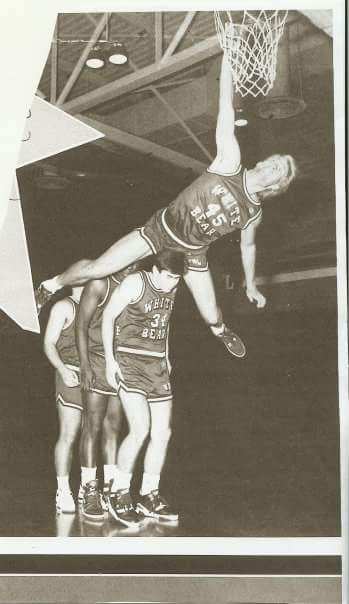
Sports was pretty cool cause I grew up around my brothers teams and they didn’t lose for 2 years at White Bear, think about that. They were 52-0 over 2 years...it was just bedlam but I got to watch their work ethics! And I started dunking in 7th grade, which is weird but cool, I got second in a dunk competition my senior year...I think it’s actually one where I ended up hurting myself permanently, and I slipped and landed on my back.
FB_IMG_1444150603173.jpg
So then I quit football, focused on basketball with a little baseball. Then baseball took over by going to the Junior Olympic Festival(1) in ‘89.  Coach was bold enough to pick 3 Minnesota guys to be on this 12 state team. So we’re in Oklahoma, and the stadium was packed and we get announced White Bear, Minnesota, St. Paul, Minnesota...everyone was rippin’ on us but... we won. That’s when I sort of got thrown in the national spotlight. But, then I signed to Oklahoma to just play baseball. So I was getting ready to go there when the Twins drafted me in the third round in 1990 right out of high school and off I went. But it was a long way, man. I was away from my family and girlfriend. I went to a bible study at the end of the year led by a guy named Gary Carter(2), wound up being a Hall of Fame player. And I just wanted to meet him! But...it cleared my vision...do I want to be “The Big League” guy or that guy? So that is when I gave my life to Christ and that’s kind of a Fellowship of Christian Athletes(3) thing and from that, it’s what makes me passionate for it. I was raised as a Christian but it wasn’t until 18 that I understood the concept of Personal Savior and the personal relationship. So, religiously, yeah Lutheran taught me how to pray and everything; I had a relationship with God and had a clear understanding of a lot of things, which I am grateful for but, again, it wasn’t until, ya’know you’re all on your own and you kind of got to decide for  yourself...and that’s when life changed.

So the adversity was a couple things! One, I knew I wouldn’t do this, but my roommates were taking steroids. It would help the healing a lot and I would be able to stay on the field. But it was getting worse. The Twins didn’t know how bad my back was and how cracked it was. It was always my back that was the problem and an injury would be made up...well, not made up but I guess made worse than it really was like in my shoulder. I didn’t have to be but I chose to be a little bit dishonest about that so that it wasn’t always my back. I wasn’t really trusting God’s plan there. We had our daughter, Elise, and I put it clear in my heart that I’m done with sports. Time to be a dad.

Being a Light

Sure sports got done and I went and finished my degree at Concordia, Saint Paul. I have a Child Psych degree and I worked at a children’s hospital where I did start my internship, Fairview University(4). That was cool but I didn’t realize that I wanted to be more of an entrepreneur. I started a real estate team, did that for 12 years. During that time we built Manitou station(5)...a little restaurant and bar facility in White Bear Lake, put up a nice facility...what else have I done…? I’ve done a lot.  Ya’know, then the last...oh I don’t know how many years, I’ve dealt a lot with death and dying; first with my father-in-law... I lived in his house with him until he passed away from a disease called Huntington’s...he gave me my wife’s life and he served my country so I wanted him to pass in the dignity he deserved...um so I did that and once I got done with that I started getting back into the other stuff again...--and then my parents started having health problems. So that just made me kinda think okay...I need to cut away from doing the entrepreneuring stuff and need to focus on...on just getting “regular” jobs and things so I can take care of my folks. Instead of wanting to raise money for Huntington’s here, or Dementia for my mom, or lung cancer awareness for my dad, I’m thinking...why prolong lives if they still don’t get to hear truth. So that’s when God put it clear in my heart we need to start pulling people in on His team, then quality of life happens because of it...so you’re doing both of them with one opportunity.
...

You see, my biggest adversity was my back. Second adversity was just being able to say no to doing stuff I didn’t want to do. I did have a team meeting at Hooters but I decided, years before, I’m not even gonna go there...any bar actually. So I decided no bars with teammates. That decision led to the toughest peer pressure moment of my life and it was--did I ever tell you the Puckett story? Well, Kirby Puckett, the biggest, most successful sports figure in the state of Minnesota...was just a super teammate. So here I am in my first big camp, wanting to impress like everyone else. Like I said about Carter, “I wanna be like that guy” and not being perfect but, it’s kinda like you know like building a blueprint for your life...let’s go back to the restaurant. When you’re building a restaurant, the blueprint isn’t just so you build what you wanna build, it’s so you don’t build something you don’t want. So when construction starts going wrong, you can go “whoa stop”. You need to do this or get outta here. That’s what we all need to do in life. I’m trying to build a penthouse, but you could quickly build an outhouse with a few decisions based on not knowing where you wanna go. So we’re there. Puckett’s a super inclusive guy, but like off the field he was not exactly perfect, but he was 100 percent. Whatever way he was going, he was going 100 percent. So anyways he comes into the room and there’s 52 of us in there and he says, “We’re going over to (some strip club) and I’m going to treat White Bear and we’ll all have a good time!”  He had nicknames for everyone and mine was White Bear Flash. So he goes, “Come on let’s go, let’s go!” and I didn’t get up. I’m supposed to go follow him, supposed to have a great time. He kinda stopped and looked and said, “Come on,  let’s go.” And the words that came out of my mouth I thought were spirit led cause when I say, “I’m not going. I’m not going to do that” that makes the person feel like they’re lower than you. So the words that came out of my mouth were, “That’s not my game Puck.” I had never said anything like that. So, “Alright. Alright, let’s go.” All that night the rookies are like, “What are you doing, you moron? I know you aren’t into that but you could just go along, not do anything and not disrupt stuff.” I don’t exist in there. I don’t want to build an outhouse. So the next day this just shows how great of a leader Puck is, he comes in but, he always uses your nickname. If he uses your name, you’re in trouble, most of the time, because he’s very vocal; kinda like Torii. So he walks into the room and goes, “Ogden!” and it just got really quiet. I go, “Yeah Puck?” “Hey man let’s go and hit off the curve ball machine and we’ll work on hitting the ball the other way!” I didn’t realize it at the time, what he was doing, but ya’know, he didn’t even talk about it [the strip club incident], he just talked about hitting and baseball. He just went out of his way and found another way to relate to me. That’s being a leader. I like to tell that one in peer pressure moments. But think about it, if you don’t got people taking stances around you about anything, you’re just going to believe yourself, in yourself.

From Here on Out

Ya’know what’s cool is that I spend a lot of time on what I’ve felt-- ya’know let me put it this way; the good thing about being an athlete is that you can get a lot accomplished. But often times you put God next to us when we’re doing it. So all this time I thought I was good and right in creating jobs and trying to motivate and help people and how that’s admirable, but it wasn’t him calling me out to do that...it was me calling me out to do that. So recently, really my biggest mission statement I guess would be just to make sure anything I do is what he’s called me out to do as best I can before I do it. Cause the doors just *pshhhh* they open. Not that it’s easy, but then I’m accomplishing. I mean basically it’s like uh-- going back to the creator of the computer you’re working with,  and it’s got issues. If you want to keep it maintained and working it’s best, go back to it’s creator or the company that created it to get it straightened out..to have its best computer. So as far as from here on out, I just wanna play the right cog in the machine whatever that may be to accomplish His goal. It’s about decreasing self as much as possible because you never know what part of the machine you’re going to be asked to play. You may seem insignificant but, the machine won’t run without it. If you guys can embrace everything you’re doing, He’s going to use it in some way. Go achieve…But trust that he’ll use it in some way for its good. It’s easy to be anxious, but He’s never failed and He won’t.


Footnotes:
    1)Olympic Festival: held in Oklahoma City, the nation’s biggest amateur athletic event
    2)Gary Carter: was an American professional baseball catcher whose 21-year career was spent      primarily with the Montreal Expos and New York Mets.
    3) Fellowship of Christian Athletes: an international non-profit Christian sports ministry
    4)Fairview University: award winning, nonprofit health care system based in Minneapolis
    5)Manitou Station: restaurant in downtown White Bear Lake that Jamie helped build.

Story Facilitators:
Kalley Fleck
Flynnton Schlicht
Justin Baker

Something from Nothing

As we interviewed a 97-year-old old Jewish man by the name of Ben Badiner, he told us his story starting from the very beginning of his life. Ben has lived in the Twin Cities all his life but shortly before he was born his parents immigrated to the United States from Russia with many other Jewish families. They believed this was a good place to raise a family and was an area that encouraged a better life. As the story continues, Ben tells us of the jewelry store his father started and how it remained in business and in the family for 80 years. It was a local jewelry store that prospered greatly and was extremely popular until its close in 2008. Throughout the interview Ben was able to share with us some memories, some family history, and how the jewelry store influenced his life.

We all got along good

My name is Ben Badiner and I was born on July 24, 1918. My parents immigrated here from Russia before I was born, so I have lived here all my life. When I was a kid me and my family lived in a neighborhood in North Minneapolis. I am a Jew so as a kid there was some [discrimination] but we all got along good but there was an undercurrent of discrimination. There were black kids and people of different religions, we all got along good. There was no knives or guns even if someone was a rough character they would get in a fist fight with them but that’s all. Nobody got killed, there wasn’t so many killings and the only killings was gangsters themselves. It was more adult gangsters not the kids. There wasn’t too much little kids on the street like there is nowadays, without parents or they don’t know who their parents are. It was tough times financially to begin with. Umm I remember, well…. I lived, on the corner, I lived on 1211 Irving and next door there were some uh, Swedish people and further down the block were some colored people, black people, and we all got along good. All the Jews lived in North Minneapolis and everybody knew everyone. If you weren’t related to someone then one of your friends were and everybody watched out for everybody else. But the people next door, their name was Nelson, I remember they didn’t have any children but come Christmas time we would go and, my folks, myself and my brothers, we would go over to their house and exchange Christmas presents and then when we had Hanukkah we would do the same. They would come over to our house so we exchanged both holidays.

My journey through school

I went to Grant [Elementary] School, which was on Gerrard. Gerrard and uh, and 11th, Grant’s not there anymore. And we used to, we used to, when we lived on Irving, in grade school, I walked through somebody’s yard across the streets, Irving, Humbled, and Gerrard, because there were no busses. Sometimes we brought our lunch. And I went to Lincoln Junior High on Penn Avenue. And I finished at North High. And the classes were so big at North that they used to have a January graduation and a June graduation -- I graduated in June 1936. The classes were so big they just had to like move kids through and stuff. It was huge. There were gangs at North. There was a couple good football players, but I wasn’t good at football. I played hockey. I played hockey and baseball. We used to play football at North Commons and from Northeast they’d come over, I think from Edison High School. That was a High School at Northeast. And eventually sometimes there was a different nationalities: Polish people, Jewish people, Italians and they’d play at North Commons football on just a hard surface, hardly any grass at all, so we were pretty tough, pretty tough kids. I used to like to box but I remember once I got hit, you always take a hit when you’re boxing, but I got hit once in the ribs and that finished me off. That taught me to behave myself. I was lucky enough to graduate high school unlike many of my friends who had to drop out due to the Great Depression.

How I kept occupied

During school on 12th and Irving we moved up to 1241 Vincent, on the corner of Vincent and Plymouth, it’s about a block from Theodore Wirth golf club. In North Minneapolis the main drag was Plymouth Avenue or Golden Valley Road and Plymouth was the same as 13th and the beginning of Plymouth Avenue is this beautiful Theodore Wirth golf course so if you follow the chain of lakes and go from Lake Harriet to Isles and Cedar you go up north then you get up to where the golf course is. It’s beautiful and it’s been there for a long long time. It was golfing and you could ski down great big ski hills. I used to ski jump, I was about 17 years old.  Maybe I landed on my head one time. Anyways, so that’s where the streetcar line was, it started on Plymouth and goes up to Sheridan. We’d take the streetcar and we’d go to Emerson Avenue and transfer. The streetcar is on tracks. It followed tracks and it was hooked to something electric overhead. That’s how it ran, on the electricity. So it wouldn’t go all over like the bus it would just go back and forth. The streetcar was a pretty big deal. And then the Homewood Theatre was a big deal. What we used to do, on Newton and Plymouth there was a Homewood Theatre. One person would buy a ticket and about four or five of us, the other guys would sneak in the side doors. It was ten cents to go to the movie.  A lot of these movies have the exit doors ya know on the side so that’s where we would sneak in. And when the owner had to announce that he was raising the price to 15 cents everyone started stomping their feet because they were mad. Like, I remember once, I must have been 16 years old and that was the evening, guys went to the movie. I got a pipe for a quarter and some tobacco, and I got so sick to my stomach from it, that I didn’t smoke all my life. I never smoked a cigarette in my life. So it was a good thing it happened.

The start of it all

I would go to school then go to the store and work for my dad. He had opened a store. He started with nothing when he came here from Russia and decided he wanted to make something of himself, so he opened a store. He would go to the wholesale jewelry store and get the stuff on consignment and when he sold that jewelry he would pay [the wholesale shop]. He would go to bars and grocery stores and the great northern market, a lot of people worked there. There was the 620 club my dad used to go and he used to take me there once in awhile he called it where turkey is king. It was on Hennepin between 6th and 7th. In the 620 club they had a place called the round table in that all these guys used to meet. I just sat outside the table, just nearby and one fella could be a gangster and one could be a judge, a veteran. One was a regular judge and one just got out of jail so they all knew each other for what they were and was interesting to listen to some of their stories and then after my dad then he started at 6th and Hennepin, he started the jewelry store and again I started to work their when I was 15 and he started a few years before that. [My dad] he used to buy closeouts, he bought some raincoats, but it didn’t rain that season. [If there was a good deal he would buy it] and try to resell it.


I learned from my father to be nice to everybody

We went on and my dad was a type of a man, which I learned from him, to be nice to everybody and also if there is somebody who you really aren’t fond of too much, just don’t say anything about them. In fact, this one lady always said, “You say nice things about everybody.” I said, “Well I believe in that.” I worked since, well like I told ya he bought closeouts and he had a little store in North Minneapolis, Morgan and Plymouth and then he went on. Well I worked in the store from 15 years old to 90, I worked 75 years. My sister passed away when she was 42 and then my brother he’s a wonderful brother and he worked in the store too at that time. It was at 7th street not too far from the Radisson Hotel across the street. First we called it David’s because that was my dad’s first name. We moved from Hennepin to 7th street. We had to transition so the first store we called it David’s, and then we went on and changed the name to Badiner Jewelers on 7th. My main job at the store was selling and buying merchandise with my dad and brother. And yeah, I lived in North Minneapolis, I never knew where St. Louis Park was until I was about 15 or 16. I never had a bike my dad thought it would be too dangerous to ride a bike. He said pretty soon you will have a car. I think I drove a car when I was about 13. The car was safer than the bike. My brother Alvin went into the advertising business and at that time my son came in and later my grandson came in. We’ve been treating people right and we discounted jewelry. Even today when I was having lunch downstairs, apparently this happens often, a lady showed me her ring. She said, “I bought my ring from you about 50 years ago.” So, I thank them. I tell them, “You helped pay the rent.” We didn’t advertise a lot.We finally ended up in the IDS building on the Nicollet Mall. I enjoyed North Minneapolis there was no knives or guns. As far as people getting in scratches it was just people getting in physical fights and there were all different kinds of races and nationalities and no guns or knives. Everybody got along and then later on when I got married and my wife came in the store working. She passed away 7 years ago. My dad was a very generous man he was the kind of guy in the Depression if somebody needed some money, [if] he didn’t have it he would go borrow it for this fella that needed it, he would borrow it from somebody else and pay him back.

I knew she was my girl

Me and my wife, Anita, we met on a blind date. I had, I had a date, uh, with another, a waitress at the 620 club, and then, I used to go in there every once in awhile and have a drink, so. And then I guess a friend of mine, he picks me up with my wife Anita, his lady friend knew her and I knew right away when we went out that it was gonna be Anita. In fact, that’s the only lady I ever went steady with. So I knew. So we got engaged and then we were married over sixty years. The only time Anita would get mad at me was at the store. If a person came in the store to buy something and they couldn’t make up their mind to take it, it was either for their wife or girlfriend, I would say “Well, take it home over the weekend, take the watch home” and he’ll come back Monday and either pay me or return it. And that would be a total stranger that I didn’t even know but I usually had a knack of sizing up people and my wife, when they would walk out of the store, my wife would ball me out, but in a nice way. “How could you trust that person when you’ve never even saw them before?” she’d say. I said, “They look honest” and it worked out okay. Now ya know, it usually worked out okay because now ya know it worked out okay because the only people that sometimes didn’t pay me were the ones I knew. Then I had to look them down. Everywhere I go people will come up to me, I can’t always make out who they are, but they’ll come up to me because I look the same for like the last 50 years, and they will recognize me and come up to me because I always had an old look and they will show me all the different things they bought from the store. Just today there were even two people at lunch who did that. Especially here where it’s mostly all Jewish people who live here in this building, they know me and that they got rings from me for their kids because it used to be just almost the only place to go. My dad opened the store in 1928 and it was there up until 2008. Like I said, even today, I think there was two women said they bought their rings from me.


Images:
1. Badiner, Ben. Link: Here Store Advertisement. Ben worked at Badiner jewelers for 75 years and ran the store after his father passed away. He put his heart and soul into the store and his customers who always made sure to point out the kindness of Ben and his family.
2. Badiner, Ben. Family Photograph. This is a picture of Ben at his 75th high school reunion from North High School. At age 97 he is one of two classmates still alive.


Story Facilitators: 
Taylor Helton, Taylor Gaveske, Sydney Maloney

Terry Ganley: University of Minnesota Associate Men and Women's Swimming Head Coach and Minneapolis native

Terry Ganley
University of Minnesota Associate Men and Women's Swimming Head Coach and Minneapolis native

Minnesota swimming associate head coach Terry Ganley

It's just kind of in my blood, I guess
I think I just have a pride for Minnesota, just being in Minnesota this many years. My parents have been here, and just being the pride in who we are and what we the University[University of Minnesota] stand for. I have two sons who graduated from Minnesota, and now my older son works here. It's just kind of in my blood, I guess.
My name is Terry Ganley and I am from Minneapolis. I grew up on the North side of Minneapolis, and I lived there all through high school, and well through college. Both of my parents were born in Minneapolis, lived there their entire lives. I am the youngest of six, so I have four older brothers and an older sister. All of my siblings were within two years of each other, except I am five and a half years later than everyone. All five of them live in Minnesota in the metro area. Three of my brothers are army vets, they all served in Vietnam. One of them is a retired Minneapolis police officer and one is a retired Minneapolis firefighter.
I think we were a typical family, a family back in the 50’s. My father could probably be described as a blue collar worker, and my mom stayed at home with the six of us kids. We were a pretty close family. I was ten when my brothers started going into the service for Vietnam, and so I think that alone brings your family closer. At the time you couldn’t have two brothers serving at the same time, so my parents went through three years of one son leaving right after the other. They were into the service right out of high school, drafted at eighteen. So I think that kind of kept us close. I think the dynamic was I had four older brothers who watched out for me, or at least thought they did. I snuck a few things by.
I grew up like I said in the north side of Minneapolis, lived there in the days where there was a lot of racial unrest. Basically there was riots, and my brother at the time was a police officer. So I felt like I had a lot of exposure to that. I live in northeast Minneapolis right now which has taken a huge change. I remember when I was younger, in the fifties and sixties, that area by the Stone Arch Bridge was just industrial, you wouldn't go down there by yourself at all, and now it's beautiful. You know when I was younger everybody wanted to live in the suburbs and had houses in the suburbs, and now there's a huge shift being back in the city.
I think starting swimming at age ten obviously developed me into what I am now
I think where I was in the family, because I was the youngest, I would say that really by the time I got to be a teenager my parents were pretty tired, just because my brothers had done everything sort of imaginable that could have been done. I started swimming when I was ten, I just kind of did that one on my own, no one else in my family was really an athlete. Probably because my parent couldn’t have really afforded it, but by the time I came around my siblings were pretty much gone.
I think for me, swimming was the whole neighborhood event. I was the youngest by quite a bit, everyone else was in the deep end and I couldn’t go in the deep end. I taught myself to swim, just because I wanted to get down there where everyone else was having fun. I started competitive swimming because the boy next door joined the local club team, and was bragging about how good he was and I thought I could beat him so I joined the team. He didn't last too long, but we had a pool four blocks from our house at a section in north Minneapolis where the whole neighborhood went swimming between four and five. I think swimming at age ten obviously developed me into what I am now. Somehow, I feel like I have a connection to swimming. Whether it’s with the people I’ve known since I was ten or the people I met here. A lot of people that I swam club with swam here [at the University of Minnesota], so it’s kind of like I have an extended family here.  
There really wasn't that many athletic scholarships at the time
When I graduated high school in ‘73 it was kind of when Title IX was just coming in, there really wasn't that many opportunities. I mean, swimming back then was one of the only sports, other than track and field, that was especially organized for girls. There really wasn't that many athletic scholarships at the time, so really financially there really wasn't that many options, other than coming here[University of Minnesota]. To be honest I thought I would go for a year or two and swim, and then get married and live happily ever after. Part of that worked.
We had very minimal, really any training facilities. When I was a Freshman there was a pool across campus that did not have lockers. You carried everything around in your backpack everyday, your shampoo, your towels. We traveled in Vans, it was a two day drive to the Big Ten’s. But we were just happy to do it happy to have the opportunity. I’m not one who thinks women were treated poorly back then. It’s just the way it was and it's evolved. We didn't even think about the fact that we were lacking anything. We just did what we did what we did, and had fun.
untitled (2).png
Terry during her collegiate career as a Minnesota Golden Gopher


Thirty or forty years ago it[swimming] was not an expensive sport, I wanna say, as it is now. I mean it's pretty hard unless your parents have some money to fund you, where before it wasn't. School was so much less expensive. You know, when I was in college you could work all summer and pay your tuition. I think my first year, my tuition was fifteen hundred dollars. You could teach, and lifeguard and make enough to pay for tuition. It[University of Minnesota] was a commuter campus. No way would parents pay for you to live in a dorm when you could live five miles away for free.  People came, did their thing and then left, there was not a very high graduation rate in four years because of that. It’s changed dramatically.

untitled.png
Terry and former women’s coach Jean Freeman celebrating their first women’s Big Ten Championship win in 1999
I got my degree in physical education when I graduated, and that time there really weren't many jobs teaching unless I moved out of the metro area. I didn't want to do that, so the head coach at the time Jean Freeman kind of worked with the athletic department to secure a position for me. As women's athletics grew obviously the position grew.
I think we've always been known as kindof the blue-collar team. I think historically we've been a team that achieves through development. We get kids who come in, work hard, who enjoy working hard, enjoy working as a team and improving. I think that’s still the culture we have, and I definitely would prefer working with kids who want to work hard and improve. I don’t know if it’s more rewarding, but it’s a good feeling to me; it fits my personality.

Photograph sources(in order)
Interview facilitators:
Katelyn Sauder, Riley Bren, Amelia Gronfor